


JOINT DECLARATION BY THE MINISTERS OF AGRICULTURE AND LEADERS OF NON-GOVERNMENTAL AGRICULTURAL ORGANIZATIONS OF ESTONIA, LATVIA AND LITHUANIA
On the Fair Common Agricultural Policy for All of the European Union Member States
— We recognize the importance of the Common Agriculture Policy (CAP) as one of the EU’s underlying policies, and its considerable role not only in food supply, but also in sustainable conservation of the environment and rural areas. Due to the impact of all these factors, and in order to cope with the new challenges, it is necessary to have an internally harmonized CAP that is based on principles of solidarity, fair treatment and equal conditions for competition.— We welcome previous CAP reforms, which began shifting away from product support and contributed to better market orientation of farmers, facilitating their adaptation to the economic environment and improvement of the competitiveness of the agricultural sector. The focus of the support is increasingly being placed on the multifunctional nature of the European agricultural model and priority is given to the land management role of the farmers as providing a number of public goods beyond food supply. Since their accession to the EU in 2004, the Baltic States have already fully applied a decoupled and uniform Single area payment scheme.
— We consider that the historical references used in the process of CAP reform in 2003 for determining the levels of direct support have now lost credibility. It is no longer possible to justify the current vast differences, of up to 5 times the individual levels of support between the EU Member States, which are jeopardizing competition between farmers of the Baltic States and other EU Member States.
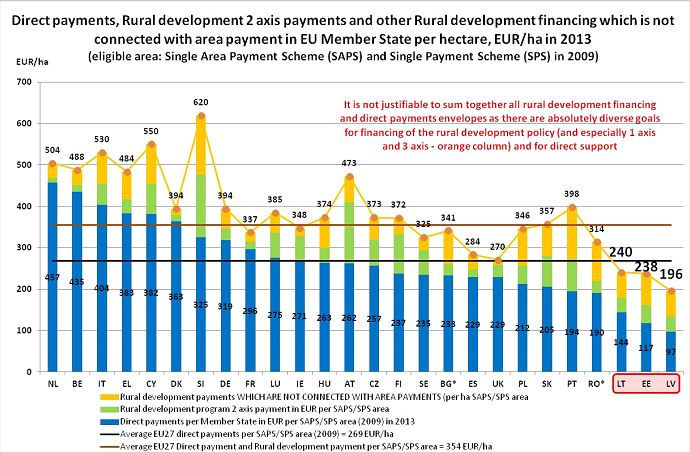
— We stress the fact that farmers of all three Baltic States, since their accession to the EU, receive the lowest level of direct support in the EU compared to other Member States. This situation restricts the farmers of the Baltic States to exercise equitable opportunities within the common EU market. Even when taking into account and summing up each Baltic State’s annual total rural development financing and direct payments envelopes, and dividing that sum to the corresponding agricultural area, each Baltic State still receives the lowest amount of EU financing per hectare (reference Appendix 1). Despite this, we have continued to comply with the same EU acquis communautaire as the other EU Member States, despite the vast differences in the levels of support across the EU.
— We emphasize the importance of the rural development policy, as a big challenge for agricultural production is ensuring food security through a competitive agricultural sector and maintaining biological diversity. As well it is important to focus on structural development, overcoming new challenges, innovation and usage of new technologies. All of which can be targeted through the second pillar.
— Referring to the European Commission proposal in the Communication “A Budget for Europe 2020” published on 29 June 2011 as well as in the future CAP legislative package published on 12 October 2011 for the redistribution of the direct support between the EU Member States post 2013, we express our overwhelming disappointment that this proposal is not economically justified. It basically means to maintain the deep division between the EU Member States in terms of the level of direct payments, by allowing the historical reference system to be in place for many more years to come, with yet another long transition period. Fundamental and significant improvements have to be made in order to ensure that the future CAP will be in accordance with the principle of fair competition laid down in the preamble of the consolidated version of the Treaty on the Functioning of the European Union, as well as the goals of the new CAP, especially with regards to market orientation. We stress our concerns regarding the equitability of the future Common Agriculture Policy, namely the ability of the CAP to function on fair treatment and equal conditions in the common EU market in the future. This issue is of the utmost importance for our nations.
— We therefore request that, commencing from the first day of the next Multiannual Financing Period, not only vital improvements in the market orientation of the agriculture sector are continued, but also that truly fair and equitable competition conditions are ensured within the whole Community market, enabling EU farmers to better respond to market signals.
— Bearing in mind the importance of fair competition and the avoidance of market distortions in the common EU market, the growing consumer demand for the delivery of agricultural products and public goods, as well as the European Commission’s own analysis which states that the overall agricultural production input costs and expenses in the Baltic States are in most cases practically the same compared to other EU Member States, we request that:
• adjustment of the distribution of the direct payments between Member states must be ensured in such a way that substantial differences between the highest and lowest level of direct payments in the European Union are avoided due to the fact that it has not been politically feasible to find common objective economic (to fulfill the basic income function) and environmental (to support the provision of public goods) criteria characterizing the actual situation;
• the amount of the direct payments for the Baltic States is set according to the new method of calculation, which shall come into full use and scale starting from January 1, 2014 without any transitional period, due to the fact that the transition period for the Baltic States has already been applied from 2004 till the end of 2013;
• an approach which decides the distribution of EU financing for rural development between the Member States shall be based on criteria that reflect the essence of the policy and the actual needs and challenges (e.g. utilized agricultural area, gross value added, NATURA 2000 area, Forest area, low population density, and the GDP per capita) and which at the same time avoids any decrease in this funding for the Member States for which the direct payments level is significantly below the EU average (reference Appendix 1);
• adequate funding is provided for both direct payments and rural development policy, and that a unified approach towards the distribution of funds across both pillars exists, in order to promote sustainable development of agriculture and rural areas within the European Union. The fact that agricultural infrastructure of the Baltic States suffered the greatest stress while transitioning towards free market economy after the collapse of the Soviet Union has to be taken into account.
— We believe that with a joint effort we will succeed in finding a reasonable solution with a view to enhance public confidence and one which will send unambiguous signals that everybody in the European Union is entitled to fair and equitable farming circumstances and conditions. We believe that all the EU Member States, including the Baltic States, will have appropriate financial resources in order to meet any new challenges in the future.
Mr. Helir Valdor Seeder, Minister of Agriculture of Estonia
Ms. Laimdota Straujuma, Minister of Agriculture of Latvia
Mr. Kazys Starkevičius, Minister of Agriculture of Lithuania
Mr. Juhan Särgava, President of the Central Union of Estonian Farmers
Mr. Edgars Treibergs, Chairman of the Board of Latvian Agricultural Organizations Cooperation Council
Mr. Jonas Talmantas, Chairman of Lithuanian Farmers Union
Mr. Aavo Mölder, President of Estonian Chamber of Agriculture and Commerce
Ms. Maira Dzelzkalēja, Vice-chairperson of Latvian Farmers’ Parliament
Mr. Bronius Markauskas, Vice-President of Lithuanian Chamber of Agriculture
Mr. Kaul Nurm, Secretary General of Estonian Farmers Federation,
Mr. Uldis Krievārs, Member of the Board of Latvian Agricultural Cooperatives Association
Mr. Vilius Kaikaris, Association of Lithuanian Agricultural Companies
Berlin, Germany
20 January, 2012
Appendix 1
Our social media accounts in English


